
The Myth of the Green
Megamachine
From Gold Rush to a New Financethropocene Era

From picks to batteries
The story of the goldfields and the story of the green transition are, at bottom, the same story told with different instruments. The first was hammered out with picks, sluice boxes, and steam; the second with spreadsheets, batteries, and algorithms. Both announce themselves as emancipations of mankind, and both threaten to become, instead, new phases in the long subordination of human communities and landscapes to a machinery of profit.
The Gold Rush Megamachine
The California Gold Rush did not merely send men into the rivers with pans; it summoned into being a primitive version of what later generations would recognise as the modern technocracy. A vast authoritarian technological system or sociotechnical apparatus that organises people like machine parts where Gold was its sacred object, but its real genius lay in the giant apparatus that crystallised around the fever. The camps along the rivers were ostensibly collections of free individuals, but in practice they were nodes in an emerging system that converted hope and sweat into capital.
Most miners did not find riches. Their labour, their hunger, and often their lives were the raw fuel. Wealth accumulated elsewhere, in the counting‑houses and warehouses of San Francisco, in the ledgers of merchants like Samuel Brannan who sold tools at inflated prices, and in the durable fabric of Levi Strauss’s work clothes. The banks, express companies, and railroad interests soon learned that the true gold was not the metal in the pan but the flows of men, goods, and information that the metal set into motion.
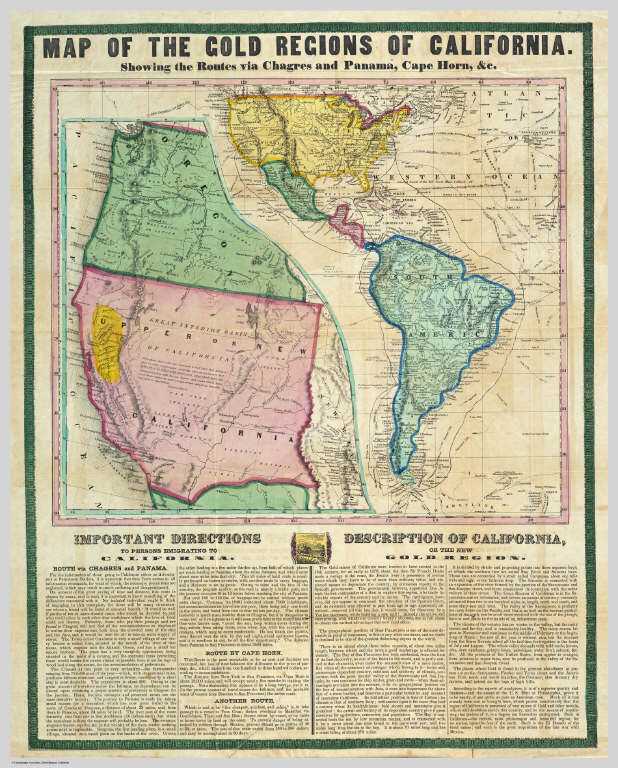
For the Native peoples of California, the Gold Rush was less an episode of adventurous migration than a drastic acceleration of conquest. Violence, dispossession, and disease tore through societies that had shaped the land over millennia. Hydraulic mining and industrial extraction did to the rivers and hills what the new order did to the indigenous communities: eroded, uprooted, and washed away. The “frontier” here was not a blank space but a pre existing tapestry, ripped apart to make way for a crude but effective industrial order.
From Aurum to Lithium
Our present “green rush” announces itself as a moral reversal of that history. Where the nineteenth century waded into streams for gold, the twenty first bores into salt flats and mountains for lithium, cobalt, and rare earth metals; where the old machinery belched smoke, the new promises clean air and a stable climate. Yet the underlying pattern is hauntingly familiar.
Again there are the diggers: the installers on rooftops, the workers in battery plants, the communities along new mining frontiers. Again there are the pilgrims who invest their savings or their careers in the promise of a better world. And, once more, the largest rewards gravitate toward the merchants and organisers of the new order: the manufacturers of solar modules and wind turbines, the conglomerates that refine lithium and cobalt, the firms that package “green” portfolios for anxious investors. The names—Tesla, BYD, CATL, Albemarle, BlackRock—are different, but their structural role resembles that of Brannan, Strauss, and the railroad syndicates.

The green transition is frequently described as a race against time, a planetary emergency that brooks no delay. In such conditions, instruments that in quieter epochs might be debated—subsidies, carbon markets, ESG mandates—are ushered in as necessities. The result is an immense redirection of capital, sanctioned by public policy yet orchestrated largely by private institutions, all under the sign of sustainability. As in the mining camps, the rhetoric is one of opportunity and renewal; the ledger may tell a more concentrated tale.

The Green Megamachine
To echo the Gold Rush Megamachine, the green machine being vast authoritarian technological system or sociotechnical apparatus that organises people like machine parts where sustainability is its sacred object, but its real genius lay in the giant apparatus that crystallised around the fever. The niche industries that developed along the way were ostensibly collections of free individuals, but in practice they were nodes in an emerging system that converted the goal of sustainability and fear of climate change into capital.

The Finanthropocene Era
The term Anthropocene was coined to name an epoch in which human activity has become a geological force. Yet “humanity” here is an abstraction, smoothing over vast disparities of power and responsibility. What stands astride the planet is not an undifferentiated species, but a set of interlocking financial, corporate, and technical systems that bend landscapes, labour, and even climate policy toward specific ends.
For this reason, the age might more accurately be called the Finanthropocene: an era in which financial logics, rather than human needs as such, are the decisive agents remaking the Earth. Carbon itself becomes an entry in the account book; forests, wetlands, and even atmospheric “services” are abstracted into units that can be bought, sold, and hedged. Instruments such as carbon credits, green bonds, and nature based offsets claim to reconcile economy and ecology, yet too often they transpose living systems into a domain where only those with large balance sheets can truly act.
In this new order, the pattern of the Gold Rush repeats at planetary scale. The “miners”—small communities in forest regions, coastal cities facing sea level rise, workers in new energy zones—are promised inclusion in a green future; instead, they frequently find that their lands, data, or labour have been reclassified as assets in distant portfolios. The same operations that once pushed aside indigenous Californians in the name of progress now risk side-lining non Western ways of land and life in the name of climate finance. Migrants are now labelled with the prefix "economic" and indigenous first world communities now fear being eroded, uprooted, and washed away. What appears as planetary stewardship in the prospectus is, on the ground, often a rearrangement of rights and burdens.
Toward a Technocracene
The machinery of the Financethropocene does not operate by money alone. It leans increasingly on vast computational systems: models that forecast climate futures, algorithms that allocate capital, platforms that monitor energy use and credit flows in real time. Decision making retreats into technical enclosures, administered by specialists whose authority rests not on shared judgment but on the opacity of their tools.
This is the emerging Technocracene: an order in which technical and financial elites, armed with artificial intelligence and planetary data, manage both risk and aspiration. In such a world, the promise of participation is often reduced to the promise of optimisation. One is not invited to deliberate on the ends of collective life, but to adjust one’s behaviour to suit the parameters of a system presented as inevitable.
In the nineteenth century mining camp, the machinery was visible: water cannons scouring hillsides, rail lines carving through mountains. In the Technocracene, much of the apparatus disappears into code and contracts. Yet the essential question remains the same: who commands the machine, and for what purpose?


Recalling the Human Measure
To place the Gold Rush and the green rush side by side is not to deny the necessity of responding to climate disruption, any more than recalling the brutalities of the nineteenth century is to deny the creative powers it unleashed. It is, rather, to insist that the means by which humanity addresses its crises are never neutral. They either deepen the megamachine or begin to humanise it.
The task, then, is to resist the seduction of an automated salvation in which a union of finance and technology, draped in green, promises to rescue the very world it continues to disassemble. A civilisation worthy of the name would not content itself with substituting lithium for gold, or algorithms for overseers, while leaving intact the underlying structure that treats land, labour, and life as mere inputs. It would recover the human measure: the capacity of communities to shape their tools, their landscapes, and their futures without being reduced to fuel for the latest rush.
Bibliography
https://en.wikipedia.org/wiki/California_gold_rush
https://www.ncpedia.org/anchor/california-gold-rush
Mumford, L. (1934). Technics and Civilization. Routledge & Kegan Paul Ltd. https://doi.org/10.5840/zfs19354343
Mumford, L. (1964). Authoritarian and Democratic Technics. In Technology and Culture (Vol. 5, Issue 1). Winter.